

 Gignaati Gigs
A CFO I heard about recently — through a client, not directly, so take it as anecdote rather than data — rolled out ChatGPT Enterprise licenses to four hundred people and then wondered, three months later, why usage had flatlined at 12%. He’d bought the tool. Nobody had taught anyone what to do with it.
That story isn’t rare. It’s the default outcome, actually, when a company treats AI adoption as a procurement decision instead of a people one. You can hand someone the best software in the world. Without training, most of them will open it twice, get an unhelpful answer, and quietly go back to doing things the old way.

Which is really the whole case for AI training for employees, stated plainly: the tools already work. The bottleneck is almost never the model anymore. It’s whether the person sitting in front of it knows what to ask, how to check the answer, and where the thing is actually useful versus where it’ll waste their afternoon.
There’s a comfortable assumption floating around a lot of leadership teams — that AI is intuitive enough that people will just pick it up. Employees use their phones without a manual, so why would ChatGPT be different?
Here’s the problem with that logic. Using a phone is mostly about muscle memory built over a decade of casual use. Using AI well is a skill — prompt structure, knowing when to verify an output, understanding where hallucination risk is highest, recognizing which tasks are genuinely faster with AI and which ones just feel faster while actually creating rework. None of that is intuitive. It’s learned, the same way spreadsheet literacy or CRM literacy had to be learned a generation ago.
Skip the training, and what happens instead is a fractured office: two or three self-taught power users pulling ahead, everyone else either avoiding the tools out of low-grade anxiety or using them badly enough that outputs need heavy correction. Neither outcome is what leadership pictured when they signed the licensing agreement.
[VISUAL: bar graph — AI Tool Adoption Rate at 90 Days, comparing “No structured training” vs “Structured AI training for employees,” across three metrics: daily active use, task automation attempts, employee confidence score]
I’ll be blunt about something the vendor decks tend to oversell: AI won’t 10x your team’s output by itself. What it does reliably do — when people actually know how to use it — is claw back the hours lost to genuinely tedious work. First drafts of routine emails. Meeting summaries. Pulling structure out of messy data. Initial research passes before a human does the real thinking.
Add that up across a fifty-person office and it’s not marginal. It’s often the difference between a team drowning in admin and a team that has room to actually think. But that gain only shows up after training closes the gap between “has access to AI” and “knows how to use AI inside their specific job.” Skip that step, and you’re paying for licenses that sit mostly idle.
Here’s a quieter reason AI training for employees matters, and it gets less airtime than the productivity angle: risk. An untrained employee treats an AI-generated draft the same way they’d treat a colleague’s — assume it’s roughly right, maybe skim it, move on. That’s a fine habit for a colleague’s work. It’s a genuinely risky habit for AI output, which can be confidently, fluently wrong in ways that don’t look wrong on a first read.
Good training teaches the skepticism that has to sit alongside the speed. Where to double-check a number. When a citation needs verifying before it goes in a client-facing document. Which categories of task — legal language, financial figures, anything client-sensitive — need a human sign-off no matter how polished the AI draft looks. Skip this part of training and you’re not just losing productivity. You’re accumulating quiet risk that surfaces at the worst possible moment, usually in front of a client.
Not every AI training program earns its budget line. The ones that do tend to share a few things in common.
They’re hands-on. Employees build something real during the session — an automation, a working prompt template for their own recurring task, a small AI agent — rather than watching a demo and nodding along.
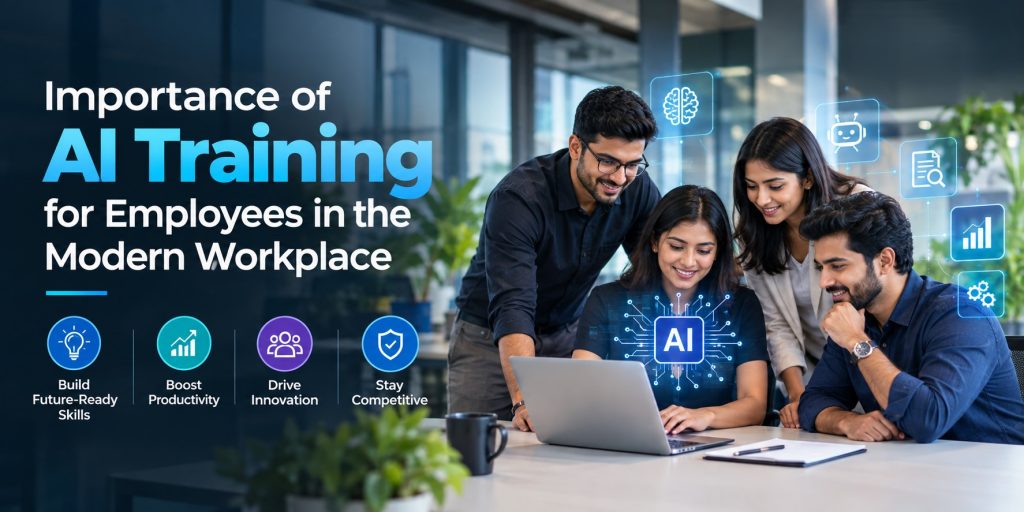
They’re role-specific past the first session. A sales team and a finance team need almost nothing in common from AI training beyond the basics. Gignaati’s BADGE framework structures around exactly this — a shared foundation, then tracks that branch by what the employee actually does day to day, through to building and shipping a working AI agent tied to their own role.
And they don’t end the day the workshop ends. The best programs build in a follow-up window — office hours, a support channel, a short refresher a month later — because the real test of training isn’t the quiz at the end. It’s whether someone’s still using what they learned two months out, unprompted.
Companies that skip structured AI training for employees don’t save money. They defer the cost and pay a worse version of it later — in inconsistent AI use, in rework from unchecked outputs, in a handful of self-taught staff quietly leaving because there’s no path to grow their AI skills where they are. Training isn’t the expensive option here. It’s the one that prevents the more expensive mess.
If there’s one thing worth taking from all this: don’t buy the tool and assume the skill follows. It doesn’t. The skill has to be taught, practiced, and reinforced — same as every other capability that ever mattered to a workplace.
Ease of access isn’t the same as skill. Employees can open an AI tool in seconds, but using it well — structuring prompts, verifying outputs, knowing which tasks it’s actually suited for — is a learned skill, not something people pick up by accident.
Almost all of them can benefit. Still, the lesson plan should change with the job. Sales, finance, HR, and operations do not use AI in the same way. Because of that, role focused modules usually work better than one general class.
In many structured programs, people start using AI in daily work sooner than expected. Some see clear improvement in about a month to three months. This happens best when the course has real practice. It also helps to have support after the first sessions.
Yes. Good training puts a lot of weight on checking work. Employees learn when a human review is needed. They also learn where wrong answers are more likely. And they learn which tasks must not be sent out without a final look.
Look for hands-on building rather than passive demos, role-based tracks instead of one generic session, and a support structure that extends past the last training day — not just a certificate at the end.
Explore Gignaati.com – where top AI innovators showcase verified AI agents for real-world solutions.
© 2025 Gignaati is a product of Smartians.ai. All rights reserved.
 Visit Main Gignaati Website
 Learn with Gignaati Academy
 Explore Workbench
 Partner with Us
 Invisible Enterprises – Buy on Amazon
 Terms & Conditions
 Privacy Policy
Leave Your Comment