

 Gignaati Gigs
HR is turning into one of the most AI-affected functions in any company — hiring, onboarding, the daily admin, all of it. Here’s what’s actually shifting, what your team needs to learn, and how to get there without a year of retraining.
Ask around about which department AI upends first and people say engineering. Maybe marketing. HR rarely comes up.
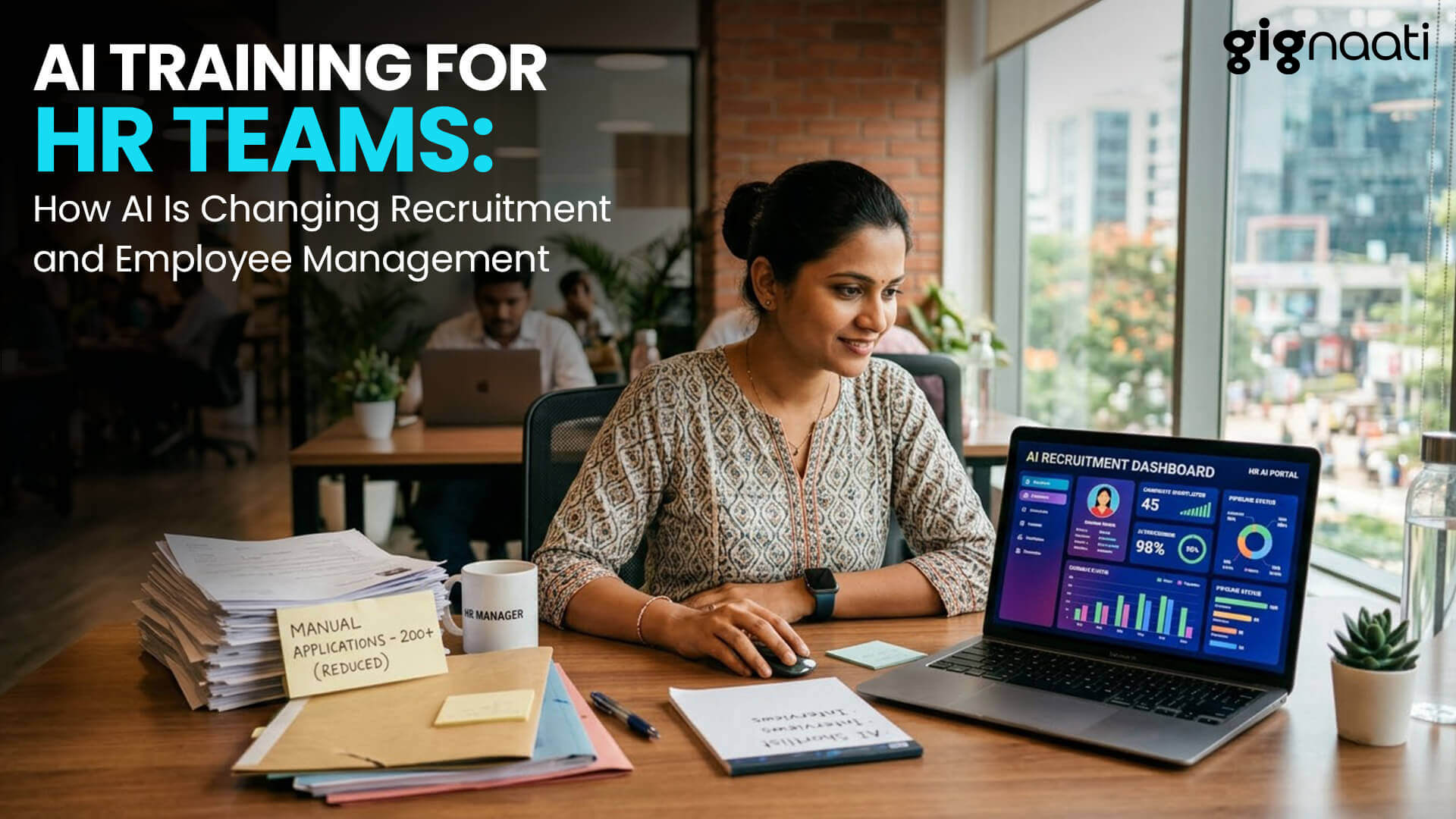
They’ve got it backwards. Look at what an HR team does on a normal Tuesday — reads a stack of resumes, answers the same three policy questions eleven times, books interview slots, chases an onboarding checklist, pulls a report together at month-end. Every one of those is high-volume and pattern-heavy. Which happens to be the exact shape of work AI is good at.
So this isn’t a threat to HR. It’s probably the best thing to happen to the function in a decade. The screening that swallows a recruiter’s week, the FAQ a new joiner asks for the hundredth time, the report someone builds by hand every month — hand that layer to AI and you get the hours back for the part that needs an actual person. The judgement. The awkward conversation. The read on whether someone will fit.
Here’s the catch, though, and it’s the one that sinks most HR teams. Buying an “AI recruiting tool” and hoping for the best does nothing. The teams that get real value are the ones whose people genuinely understand what AI can and can’t do — and who can get the right build skill in the room when they need something custom. That’s the whole subject of this piece.
Makes sense that hiring goes first. It’s the most repetitive corner of HR and the highest-volume. Here’s what’s working right now — actually working, not working-in-a-demo.
Resume screening and scoring. The old time-sink. An agent reads every CV that lands, pulls out what matters, scores each one against the role. A two-day manual sift becomes a few minutes. You can already grab ready-made agents on marketplaces like Gignaati that screen and score resumes straight out of Gmail into a sheet — so even a two-person team gets proper screening without building a thing.
CV parsing. Resumes show up as messy PDFs. AI turns them into clean fields — name, skills, experience, contact — that drop straight into your ATS. Unglamorous plumbing. Makes everything after it faster.
Sourcing signals. AI can comb job boards and public data for firms that are hiring or people who fit, surfacing leads a recruiter would never dig out by hand.
First-round screening. AI forms and chat can run a structured first pass — same qualifying questions, every applicant, any hour of the day. Recruiters then spend their time on the shortlist instead of the slush pile.
One thread runs through all of it. AI does the volume and the consistency; the human does the judgement. A recruiter who spent 70% of the week sorting now spends it interviewing.
Recruitment grabs the attention. But managing people once they’re in the door is where the deeper change is happening.
Onboarding is the obvious one — an assistant that answers a new joiner’s endless “where do I find” and “how do I request” questions on the spot, so HR isn’t a human help desk for someone’s first two weeks. Then there’s the daily query pile: leave balance, reimbursement steps, policy clarifications, all answered from your own documents, round the clock, in the person’s own language. Engagement, too — AI can spot a pattern across surveys and feedback that nobody has the hours to read manually, and flag a problem before it turns into an exit interview. And the admin: the reconciliation, the status update, the thing that gets copy-pasted between two systems every week. Gone.
None of that replaces the HR business partner. It clears out the busywork that stops them being one.
This is the bit most “AI for HR” advice skips straight past. Tools don’t transform a function. Trained people using tools well do. And “AI training for HR” isn’t a single thing — it’s three separate levels, and a decent programme hits all three.

Level one is literacy. Everyone in HR should get, in plain terms, what AI reliably does — screen, summarise, answer from documents — and what it doesn’t: make the final call, exercise judgement, carry accountability. This is the layer that heads off both the fear and the over-trust. Education, not engineering.
Level two is the applied, hands-on layer. Writing a prompt that actually works. Running a screening workflow. Reading an AI shortlist with a critical eye instead of rubber-stamping it. Catching the model when it’s confidently wrong. This is where the day-to-day productivity lives, and you only learn it by doing — on real HR tasks, not toy examples.
Level three is the one nobody lists, and it matters most: knowing when to call a builder. HR people don’t need to become engineers. They do need to recognise the moment a task needs something custom that no off-the-shelf tool covers — and to know the fix is a specialist, not a six-month internal project. Knowing the edge of your own capability is a skill in itself.
Level three is where a lot of HR AI ambition quietly dies. Not because the idea was bad — because the team hit a build wall and had no idea there was a fast way round it.
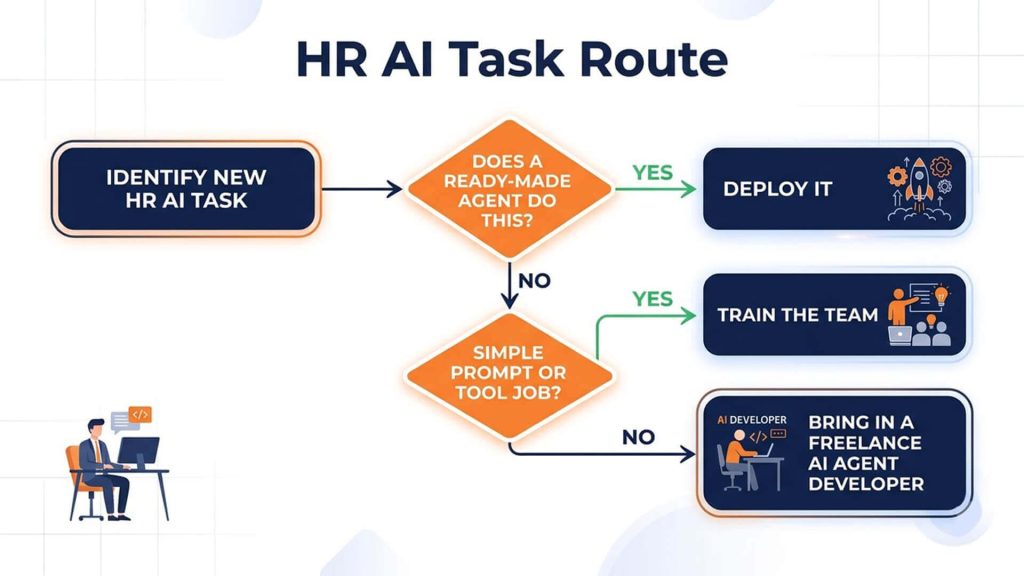
[FLOWCHART — HR AI TASK ROUTE]
For any HR task you want to AI-enable: does a ready-made agent already do it? → if yes, deploy it → if no, is it a simple prompt/tool job? → if yes, train the team → if it needs custom building, bring in a freelance AI agent developer to build it fast.
Every HR team that gets serious about AI hits the same wall eventually, and it’s worth naming because it’s so predictable.
The ready-made tools cover the common stuff beautifully — screening, FAQ bots, CV parsing. Then you want something that fits your process. An onboarding agent wired into your exact systems. A screening flow tuned to that odd mix of roles you hire for. An engagement analyser that reads your particular survey format. Off-the-shelf gets you 80% of the way and then doesn’t quite fit — and nobody in HR can build the last 20%.
That’s the fork. HR teams that scale their AI use go one way; the ones that stall go the other. And the instinct at the fork is usually wrong — either abandon the custom idea, or kick off a slow internal project. There’s a third option, and it’s the good one: borrow the build skill.
When you hire AI developers in India through a verified marketplace, you get someone who’s built this exact kind of thing before, working on your task, in days rather than the quarters a full-time hire would eat. Hand a freelance AI agent developer your half-formed idea — “an agent that screens for our three weirdest roles and flags culture fit” — and they turn it into a working tool while your HR team watches it come together and learns what’s actually possible. Gap closed now. People levelled up on a real build instead of a slide.
For HR specifically, this fits almost too well. You’re not signing up for a permanent AI hire before you’ve even proven the use case pays off. You start with a scoped, cheap gig — some HR agents on these marketplaces open at a few thousand rupees — see whether it genuinely saves time, then decide what’s worth building on top. Gignaati was made for this: an HR team can grab a ready-made screening agent, tweak one to fit, or hire a freelance AI agent developer to build something bespoke, and close the gap in days.
The whole thing, as a sequence any HR lead can run:
Run that, and HR stops drowning in the repetitive layer and starts doing the work the business actually hired it for.
AI is reshaping HR faster than almost any other function, for a simple reason — HR runs on exactly the high-volume, pattern-heavy work AI eats for breakfast. But the tool on its own changes nothing. Trained people change everything. Get the team to baseline literacy, deploy the ready-made wins, drill the applied skills hard — and when you hit a custom build you can’t do in-house, know that the fastest route is to hire AI developers in India through a marketplace, not to stall or over-hire. The HR teams that come out ahead over the next few years won’t be the biggest. They’ll be the ones who learned what AI could do, and knew the exact moment to bring in a builder.
It takes over the high-volume, repetitive end of hiring — screening and scoring resumes, parsing CVs into clean data, running consistent first-round questions, digging hiring signals out of job boards. A multi-day sift becomes minutes, and recruiters get to spend their time interviewing and closing instead of sorting. The judgement stays human. AI just clears the pile that used to bury it.
Three levels. Literacy — a plain-English grasp of what AI can and can’t reliably do. Applied skills — hands-on practice writing prompts, running screening workflows, reading AI output with a critical eye. And knowing when a task needs a custom build beyond off-the-shelf tools, plus the fact that the fix is a specialist, not a long internal project. Most training stops at the first two and leaves teams stranded at the build wall.
Mostly, yes. Ready-made agents on marketplaces already handle the common HR jobs — resume screening, CV parsing, onboarding FAQ bots — with no building needed; the team just needs applied training to use them well. For anything custom to your own process, you don’t hire a full-time engineer. You bring in a freelance AI agent developer for a scoped project, which is quicker and far cheaper than standing up an internal AI team for one workflow.
Borrow the build skill rather than hiring for it. Through a verified marketplace you can hire AI developers in India and have a specialist build your custom tool — an onboarding agent, a tailored screening flow — in days, not the nine to twelve months a full-time hire takes. Start with a scoped, affordable gig, check it saves real time, and let your HR team learn on the live build so the capability partly stays with you.
Explore Gignaati.com – where top AI innovators showcase verified AI agents for real-world solutions.
© 2025 Gignaati is a product of Smartians.ai. All rights reserved.
 Visit Main Gignaati Website
 Learn with Gignaati Academy
 Explore Workbench
 Partner with Us
 Invisible Enterprises – Buy on Amazon
 Terms & Conditions
 Privacy Policy
Leave Your Comment